Product decisions, explained

Make a decision you can explain.

Compare product options, keep the evidence and tradeoffs behind your choice, and revisit it when you learn something new.

Keep the notes behind your choice
Relay · fictional exampleDraft

Test a readiness checklist

Chosen action
Test request readiness before a reminder-only build.
Evidence change
Four of five invented overdue cases lacked documents.
Next test
Try a paper checklist before committing to software.

Fictional evidence. Effectiveness remains unknown.
ta·ra·zu/noun/the balance scales.
How it works

From a request to a decision.

Add what you know, compare the options, and save why you chose one. Return to the record when something changes.

  1. Listen

    Pull requests, feedback, data, and ideas into one place.

  2. Score

    Weigh each option against the criteria your team cares about.

  3. Decide

    Rank with a clear, shared rationale anyone can trace.

  4. Record

    Record your choice, expected outcome, and review date.

  5. Review

    Record what happened, add new evidence, and choose whether to keep, revise or retire the direction.

Record · fictional Relay example
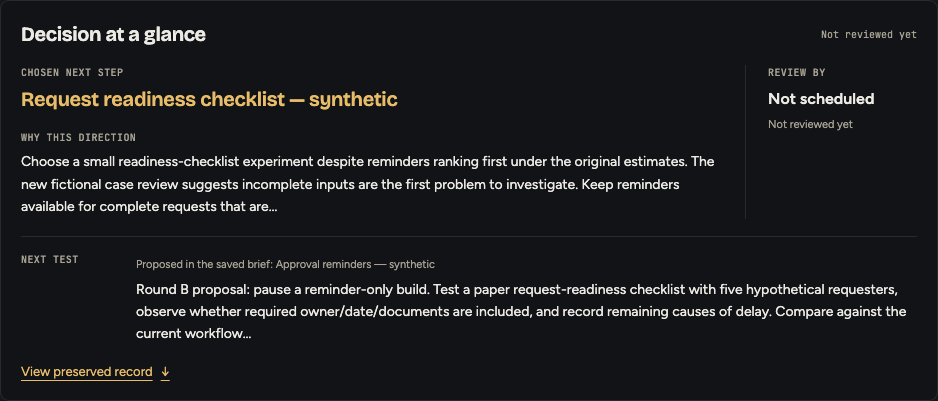
Fictional Relay Round B decision at a glance, with the chosen checklist, reasoning, next test and review status.

A saved draft keeps the choice, evidence and next test together.

Fictional example. No real participants or measured results.

View full-size example ↗
New findings become part of the next review
A worked example

A smaller test, with the reasoning attached.

A fictional team starts with a reminder idea, looks at conflicting evidence, and chooses what to test before committing to a build.

The saved draft keeps the original context available for the next discussion.

Relay · fictional exampleDraft

Saved decision · Round B

Test a readiness checklist first

The choice
Test a paper readiness checklist before committing engineering time.
What changed
Four of five invented overdue cases lacked required documents; one was overlooked. This made readiness worth testing before a reminder-only build.
Next test
Try the paper checklist with five hypothetical requesters; observe missing owner, due date and documents. Planned review: October 30, 2026.

Fictional evidence. Small sample; effectiveness and prevalence remain unknown. No real participants or results are represented.

The choice keeps the evidence and tradeoffs attached.

Explore this decision
What you get

See what each choice rests on.

Notes beside the options

Attach an interview note, request or data point to the option it supports or challenges.

Scoring that's consistent

Use shared Reach, Impact, Confidence and Effort definitions to compare options consistently.

A brief you can share

Copy a decision brief with the problem, choice, tradeoffs, evidence and next test into your existing documents or messages.

Return with new evidence

Record what happened, add a source, and choose whether to keep, revise or retire the direction. Earlier reasoning stays available.

RICE scorecardFictional example
All four inputs are 1–100 band scores.
CandidateReachImpactConfidenceEffortRICE index
1Readiness checklist757520157,500
2Approval reminders555520351,729
3Status dashboard15352055191
RICE index = (Reach × Impact × Confidence) ÷ EffortIllustrative priority index, not measured return.
Why Tarazu

Why did we choose this?

Keep the notes behind your choice, so the next discussion starts with the same context. You can see which sources supported it, what was uncertain, and what changed later.

Try it with a decision you need to make.

Compare two options, attach what you know, and save the next step.